The Italian foto passaporto: Official Requirements and Why Applications Fail
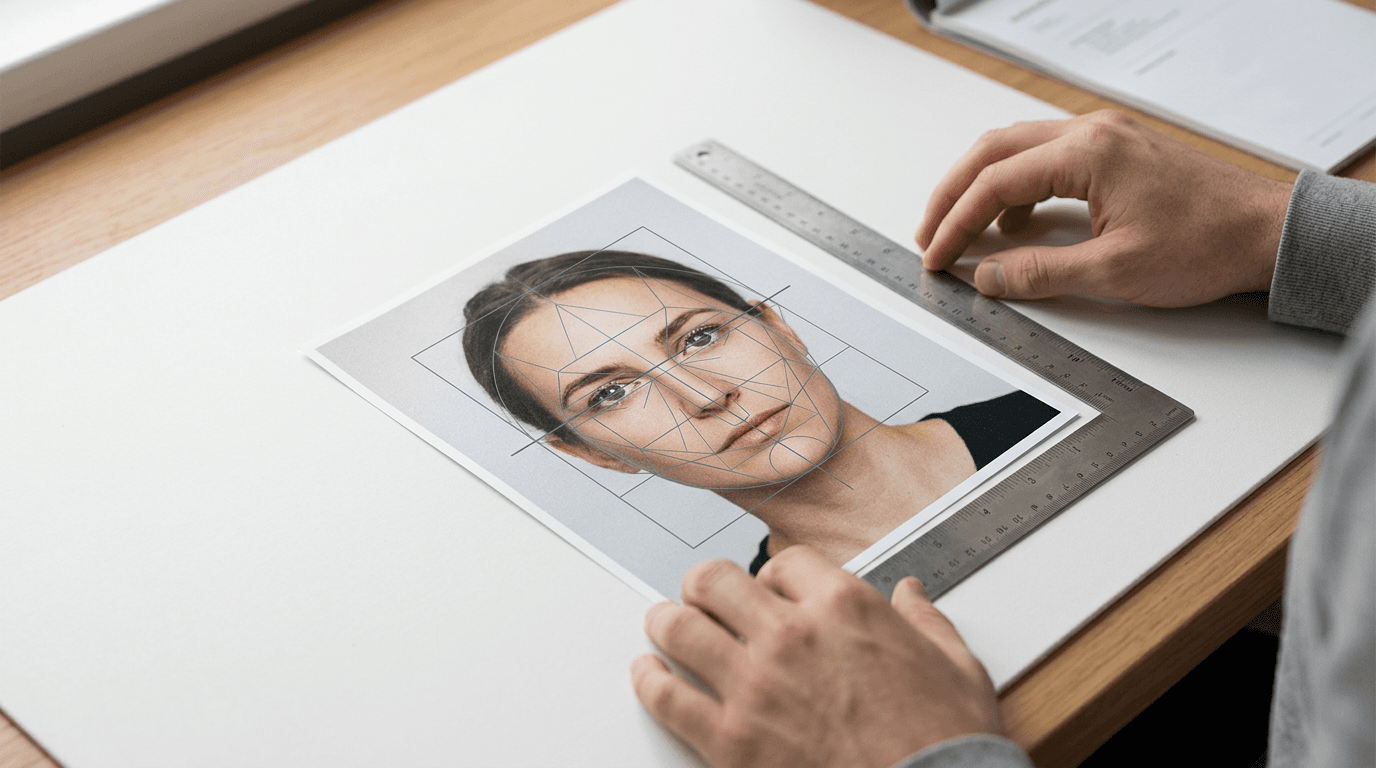
You hand your documents across the desk at the local Questura, only for the officer to slide your printed image back because a slight shadow under your chin has triggered their biometric scanner. Italian passport authorities do not evaluate images visually; they process them through automated systems designed to map facial geometry. When an image fails to align with this grid, the application stops immediately.
Preparing a compliant foto passaporto requires more than standing in front of a white wall. The technical specifications dictate millimeter-exact facial proportions, specific lighting diffusion, and strict behavioral rules during capture. Understanding how these elements interact with government software determines whether your application proceeds smoothly or requires an entirely new appointment.
Quick Summary
A valid Italian passport photo must map precisely to ICAO biometric standards, relying on strict physical dimensions rather than subjective visual quality.
- Dimensions: Images must measure exactly 35x45mm, printed on high-quality photographic paper.
- Facial scale: The head must occupy a dominant proportion of the vertical space (measuring the specific distance from chin to crown).
- Lighting: Flat, shadowless lighting is required to ensure software can map the jawline without visual obstruction.
- Infants: Babies must be photographed lying flat on a plain white background, with no hands or support objects visible in the frame.
Table of Contents
- Why the Questura rejects your foto passaporto on the spot
- Where dimensions and proportions usually go wrong
- How lighting outranks background color in biometric checks
- What changes when photographing infants and toddlers
- Comparing an accepted and rejected esempio foto passaporto
- How the foto passaporto icao standard restricts your styling choices
- FAQ
- Recommended Reads
Why the Questura rejects your foto passaporto on the spot
The system used by Italian authorities evaluates an image by identifying nodal points on the face. It locates the center of the pupils, the tip of the nose, and the corners of the mouth, calculating the exact distances between them. This geometric map is what gets encoded into the biometric chip of your new passport. If the software cannot cleanly separate your jawline from your neck, or if it cannot locate your exact pupil center due to a reflection, the image is discarded.
Most applicants assume that a sharply focused portrait is sufficient. However, biometric scanners actively penalize standard portrait photography techniques. A professional photographer might use dramatic lighting to contour a subject's face, creating a flattering shadow along the cheekbones. To the passport scanner, that shadow registers as a physical deformity or an obstruction, breaking the geometric map.
Furthermore, the physical medium matters just as much as the digital capture. The Questura requires high-quality, continuous-tone photographic paper. Standard inkjet prints from home printers create microscopic dot patterns (halftones). While these dots blend together to the human eye, the high-resolution scanners at the passport office read them as heavy digital noise or facial texture anomalies, leading to instant refusal.
Practical rule: Print passport images using dye-sublimation kiosks or professional silver-halide photo labs, never a home inkjet printer.
Where dimensions and proportions usually go wrong
The rigid foto passaporto regole require the final physical print to measure exactly 35 millimeters in width and 45 millimeters in height. But the exterior border is only the first hurdle. The internal composition - how much space your head takes up inside that rectangle - is where most self-taken photos fail.

Italian standards dictate that the face must cover a dominant proportion of the total vertical length of the image. In practical terms, the distance from the very bottom of your chin to the top of your head (excluding voluminous hair) must fit within strict vertical margins. If the camera is positioned too far away, your head appears too small, and the software's cropping tool cannot zoom in without degrading the resolution below acceptable limits. If the camera is too close, your chin or the top of your head will breach the required margins.
This precise aspect ratio is highly regional. If you attempt to submit an image formatted for different national standards, the layout will break the Italian scanner's template. For instance, the United States baby passport photo requirements demand a 2x2 inch square format. Submitting a square photo, or attempting to trim a square photo down to 35x45mm, will either ruin the facial proportions or eliminate the required shoulder clearance entirely.
Similarly, you must maintain perfectly level eye contact with the lens. The camera must be positioned precisely at eye level. Looking slightly down at a smartphone or slightly up at a webcam alters the perceived distance between your nose and your upper lip. This vertical distortion prevents the biometric mapping software from accurately calculating your baseline facial structure.
How lighting outranks background color in biometric checks
When applicants search for come deve essere la foto per il passaporto, they usually focus entirely on the background color. While a plain white or light gray background is strictly enforced to ensure contrast, the actual mechanism of failure is almost always poor lighting diffusion.
A pure white background is useless if the lighting casts a hard shadow against it. When you stand flush against a wall and use a single light source (like a smartphone flash), it creates a dark silhouette behind your shoulders and head. The software reads this shadow as part of your physical body, artificially widening your neck or altering your head shape in the biometric record.
Shadows on the face itself are even more problematic. Overhead lighting, common in residential rooms, casts deep shadows under the eyebrows, nose, and chin. If the software cannot detect the clear boundary of the lower eyelid or the exact curve of the nostril, it halts the process.
The technical requirement is flat, even illumination. This is typically achieved by using dual light sources positioned at equal distances and angles from the subject, canceling out each other's shadows.
Practical rule: Step at least 50 centimeters away from the wall to let shadows drop below the frame, and face a large window offering indirect natural light to ensure even facial illumination.
What changes when photographing infants and toddlers
Capturing biometric data for an adult relies on their ability to follow instructions and hold still. Applying these exact same geometric and lighting standards to infants requires completely different physical mechanics.
Newborns and infants lack the cervical spine strength to sit upright in a chair. Parents frequently attempt to hold the child up from behind, but if a parent's fingers, hands, or even the edge of their clothing appears anywhere in the frame, the photo is void. The authorities mandate that the subject must be the only entity visible in the image.
The standard protocol for infants is the "lay-flat" method. Place a pristine, wrinkle-free white sheet on a firm surface, such as a floor or a firm mattress. Lay the baby flat on their back. The photographer must then shoot from directly above, maintaining the camera lens perfectly parallel to the child's face. If the camera tilts, the child's forehead will appear artificially large compared to their chin, breaking the proportion rules.
Unlike adults, children under the age of one are granted minor leniency regarding their facial expression. While adults must maintain a perfectly neutral face with a closed mouth, infants are generally allowed to have their mouths slightly open, as long as it does not obscure their fundamental facial geometry. However, their eyes must still be completely open and visible. For detailed variations across different jurisdictions, reviewing global baby passport photo specifications demonstrates how minor allowances vary, though the underlying biometric needs remain the same.
Another common failure mode for toddlers is the presence of pacifiers, hair bows, or large headbands. These items obscure the jawline or forehead and cast complex shadows across the face. Before taking the photo, you must remove all accessories and wait for any red marks left by a tight headband or pacifier shield to fade from the skin, as these can be interpreted as permanent facial features by the scanner.
Comparing an accepted and rejected esempio foto passaporto
Understanding the theory is easier when viewing the differences systematically. When you review an esempio foto passaporto provided by the authorities, the distinction between a compliant and non-compliant image rarely has to do with how attractive the subject looks. It is entirely about unobstructed data.
Below is a comparison of variables that dictate whether an image passes the software check.
| Variable | Compliant Standard | Common Failure Mode |
|---|---|---|
| Facial Expression | Neutral, relaxed jaw, mouth fully closed. | Smiling, which pushes cheeks up and narrows the eyes. |
| Eye Visibility | Both irises completely visible, looking straight at the lens. | Hair falling across an eyebrow, or looking off-camera. |
| Head Alignment | Shoulders square to the camera, head perfectly upright. | "Selfie tilt" where the subject tilts their chin up or down. |
| Background Texture | Flat, seamless white or light gray. | Wood paneling, textured wallpaper, or heavy creases in a sheet. |
| Clothing Contrast | Darker clothing that separates visually from the background. | Wearing a white shirt that blends entirely into the white background. |
When a subject smiles, the zygomatic muscles contract, raising the cheeks and fundamentally altering the resting distance between the cheekbones and the chin. A smile also narrows the eyes, sometimes hiding the distinct boundary of the iris required for identification. The biometric baseline must capture your face at complete rest.
How the foto passaporto icao standard restricts your styling choices
The global framework that dictates these biometric rules is governed by the International Civil Aviation Organization (ICAO). The foto passaporto icao regulations treat your face as a barcode. Consequently, anything that obscures or alters that barcode is strictly prohibited.
Eyeglasses are the most frequent source of friction. While the official Italian guidelines technically permit prescription glasses provided the frame does not obscure the eyes and there is absolutely no glare on the lenses, achieving this is practically impossible without a professional studio lighting setup. Even a microscopic reflection from a camera flash or a window can obscure a millimeter of the pupil, causing an instant rejection. Tinted lenses and sunglasses are universally banned. The only reliable approach is to remove your glasses entirely for the photograph.
Head coverings are only permitted for religious or specific medical reasons. Even then, the covering cannot cast any shadows on the face, and it must be pulled back to reveal the entire face from the bottom of the chin to the top of the forehead, including the edges of the face where it meets the ears. Uniforms, or clothing that looks like a uniform (such as military-style jackets or camouflage), are explicitly forbidden in civilian passport photos.
Even heavy makeup can trigger a biometric failure. Cosmetic contouring alters how light hits the face, artificially emphasizing cheekbones or thinning the nose. If the facial structure in the photograph differs from the physical facial structure presented at the border checkpoint, the automated e-gates will reject the passport, forcing the traveler into a manual inspection queue.
FAQ
Can I wear makeup in my Italian passport photo? You may wear light, everyday makeup, but you must avoid heavy contouring, theatrical makeup, or any cosmetics that alter the apparent shape of your jawline, nose, or cheekbones. The image must represent your true baseline facial structure.
What should I do if my infant cannot keep their eyes open for the photo? For very young infants, patience is the only mechanism. You must wait until the child is naturally awake and alert. Tickling or startling the child often results in crying or distorted facial expressions, which will fail the biometric mapping.
Does my passport photo need a white margin around the edge? No. The final printed image must be exactly 35x45mm edge-to-edge, with no white borders. The subject's head must fit within the specified internal dimensions (32-36mm from chin to crown) without relying on external margins.
Can I print my passport photo at home if I use high-quality photo paper? It is highly discouraged. Most consumer inkjet printers leave a microscopic dot pattern that high-resolution government scanners read as digital noise or texture interference. You should print the digital file at a professional lab or using a dye-sublimation kiosk.