International Passport Photo Standards: Decoding the dimensioni foto passaporto for 2026
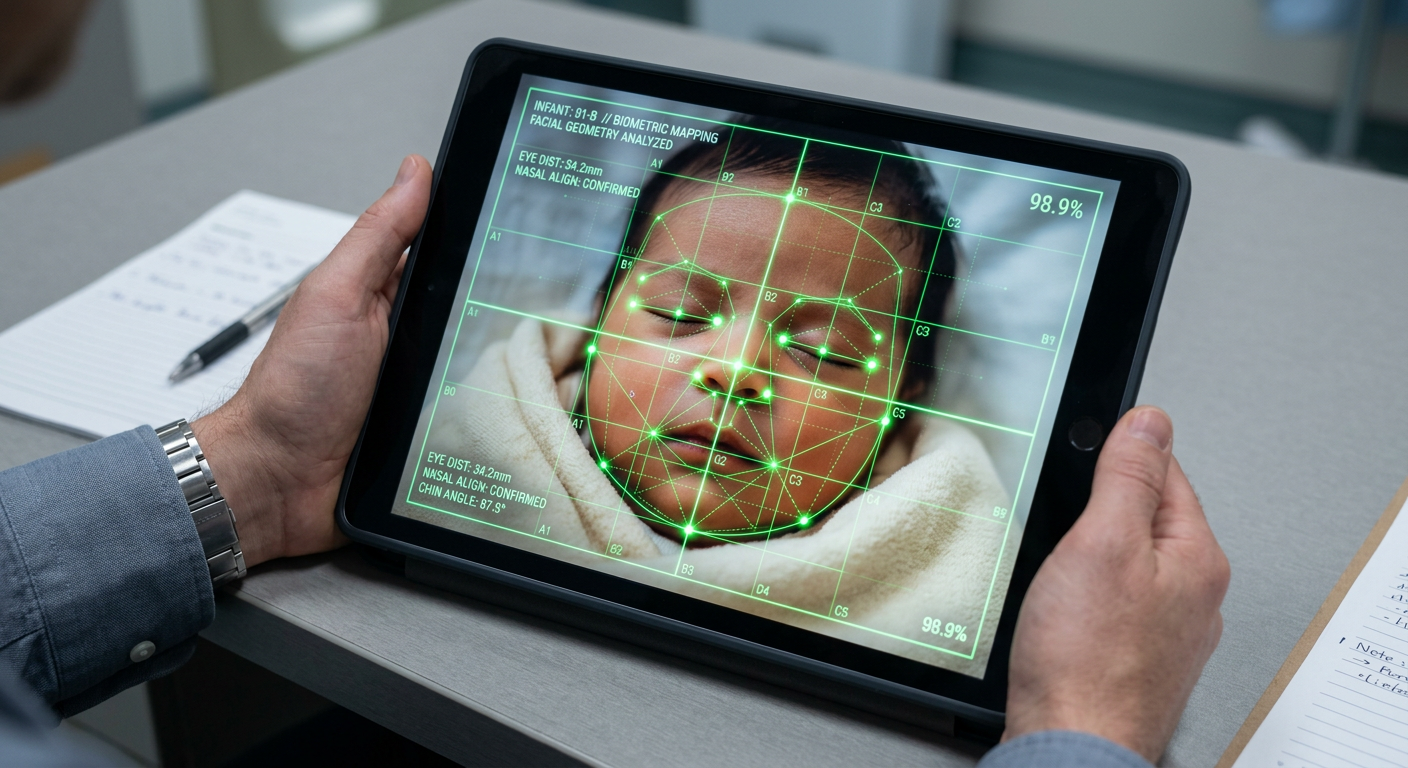
A parent opens an email from the passport office and sees a standard rejection code: "Subject face exceeds maximum allowable area." The outer dimensions were correct, the lighting was perfectly even, but the infant's chin-to-crown measurement was two millimeters too large for the crop. Filing for a dual citizenship or international travel document often sends families searching for the exact dimensioni foto passaporto, assuming a standard width and height is all that matters. That assumption fails at the biometric scanner. The physical border is just the canvas; compliance is dictated entirely by the geometry of the face inside it. This article breaks down how governments measure those internal proportions, why newborn and infant images fail more frequently than adult submissions, and how to verify your mathematical crop before handing a file to the consulate.
Quick Summary
A compliant passport image relies on exact biometric scaling within specific outer dimensions, not just a clean background. Securing the correct external border guarantees nothing if the internal chin-to-crown ratio violates the destination country's geometric mandates.
- Standard European and Schengen specifications mandate a 35x45mm outer border with the face occupying 70-80% of the vertical height.
- US standards require a 2x2 inch square format where the head measures precisely between 1 and 1.375 inches.
- Infant processing requires separate evaluation protocols for eye-line positioning, which frequently overrules standard adult facial centering rules.
- Digital applications enforce specific pixel ratios and maximum file sizes that do not perfectly map to physical printed aspect ratios.
Table of Contents
- A rejection rarely stems from the base dimensioni foto passaporto
- How lens distortion alters facial geometry
- How internal head size mandates overrule the outer border
- Why infant geometry requires a fundamentally different approach
- Four reasons a passport format photo fails biometric validation
- Translating the physical misura foto passaporto into digital resolution
- Comparing regional dimensional tolerances
- FAQ
- Recommended Reads
A rejection rarely stems from the base dimensioni foto passaporto
Most applicants fixate entirely on the perimeter. They instruct their local print shop to cut the paper at exactly 35 millimeters wide by 45 millimeters high, or exactly 2 by 2 inches, and assume the job is finished. That perimeter merely represents the physical paper cut required to fit the printed application form. Biometric scanning systems, governed largely by the international ISO/IEC 19794-5 standard, care almost entirely about the mathematical anchor points located inside that boundary. The base dimensioni foto passaporto dictate the size of the physical slot in the passport book, not the validity of the human features represented on the paper.
When government biometric software reads an incoming image, it immediately drops a coordinate grid over the subject's pupils, the bridge of the nose, and the lowest soft-tissue point of the chin. If the outer paper border is perfectly 35x45mm but the vertical distance from the chin to the top of the cranium measures 38mm, the face sits too close to the lens. The application will be rejected instantly, even though the paper fits securely into the consulate's physical sizing template.
You can manually check this before submission by measuring from the absolute lowest point of the subject's chin to the true crown of the head, explicitly ignoring any hair volume. If that specific measurement exceeds 36 millimeters on a standard Schengen-style application, the crop is geometrically invalid.
Practical rule: Measure the head inside the frame before you measure the frame itself. The scale of the facial features must dictate the final crop, never the other way around.
How lens distortion alters facial geometry
Before you even apply a crop, the physical distance between the camera lens and the subject dictates whether the resulting image can mathematically pass a biometric scan. Modern smartphone cameras utilize wide-angle lenses, typically sitting at a 24mm to 28mm equivalent focal length.
If a parent places the smartphone 30 centimeters away from an infant's face to fill the screen, this wide-angle lens creates aggressive barrel distortion. The central features closest to the lens, like the nose and forehead, bulge outward and appear disproportionately massive, while the ears curve backward and vanish from the frame. When biometric software scans this distorted image, the algorithms map a nose-to-ear ratio that does not match standard human anatomy, triggering an automated structural rejection.
To capture a biometric-compliant face, the lens must sit a minimum of 1.2 to 1.5 meters away from the subject. At this distance, the optical compression flattens the facial features into their true geometric proportions. The subject will appear quite small in the original, unedited photo file. You must capture this wider, geometrically accurate frame first, and then rely on post-capture cropping to achieve the required formatting.
How internal head size mandates overrule the outer border
Government specifications operate on a rigid two-tiered system: external cut dimensions and internal facial coverage. The United States Department of State requires a 2x2 inch (51x51mm) photo footprint, but the internal mandate forces the head to measure strictly between 1 inch and 1.375 inches from the bottom of the chin to the top of the crown. Furthermore, the empty gap between the top of the head and the uppermost edge of the photo must measure between 0.125 and 0.375 of an inch.
If the camera angle looks slightly down at a toddler, the altered perspective elongates the forehead and artificially expands the chin-to-crown measurement. Processing software interprets this tilt as a distorted cranial structure because the roll and pitch of the head deviate from a neutral zero-degree axis. To pass validation, the lens plane must be perfectly parallel to the vertical plane of the face, capturing the true vertical length without optical foreshortening.
Once that physical vertical length is captured accurately without tilt, the cropping tool scales the entire image down until the head height falls precisely into the middle of the allowed biometric range. The system aims for roughly 1.2 inches of head height on a US application, or 34 millimeters on a European 35x45mm template. Only after that internal scaling lock is established does the tool draw the final outer border. Understanding how US infant passport photo regulations strictly enforce these internal head-height ratios, regardless of the child's actual age or size, prevents the most common formatting errors.
Why infant geometry requires a fundamentally different approach
Infants possess completely different facial proportions than adults. A newborn's forehead constitutes a vastly larger percentage of their total head height, and their eyes sit significantly lower on the facial plane. If you apply a standard adult centering algorithm to an infant's formato foto passaporto, the eyes will invariably drop well below the horizontal mid-line mandated by international travel authorities.
Adult standard templates typically demand the eyes sit between 28mm and 35mm from the bottom edge of a 45mm tall photograph. Because a newborn's chin-to-eye distance is naturally so compressed, fulfilling that specific eye-line rule forces the top of the infant's head far too close to the upper boundary, immediately violating the minimum required top-margin clearance.
When passport authorities evaluate infant and toddler submissions, they generally grant necessary leeway on the eye-line positioning, provided the overall chin-to-crown measurement remains strictly inside the legal bounds. The most secure approach for formatting newborn photography is to anchor the chin at the lowest allowable threshold, such as 8 millimeters from the bottom edge, rather than attempting to force the eyes into the mathematical center. This specific adjustment prevents the oversized cranial crown from breaching the upper bounding box while maintaining adequate plain background space above the subject.
Four reasons a passport format photo fails biometric validation
Receiving a notice that "the photo was rejected" offers no actionable diagnosis. When a consulate kicks back a passport format photo, the failure almost always stems from one of four distinct geometric or lighting violations. These issues look identical at a quick visual glance but demand entirely different corrections during the initial capture phase.
1. Vertical misalignment and the floating chin
The overall face meets the sizing limits, but the vertical anchor point is incorrectly positioned. This routinely happens when the image is cropped around the dead center of the file's pixel mass rather than the center of the facial geometry.
- The symptom: The subject looks unusually low or exceptionally high in the frame, leaving either massive amounts of background showing above the head or severing the subject entirely at the neck.
- The real cause: Relying on basic "center subject" tools on a smartphone that calculate the middle of the subject's visible body mass rather than algorithmically detecting the precise eye line.
- Diagnostic questions: Does the exact horizontal center-line of the printed photograph cross below the subject's eyes? Is the empty gap above the head tangibly larger than the physical height of the subject's forehead?
2. Artificial edge degradation from background removal
Families frequently utilize generic software to replace a messy living room wall with the required stark white background. If the software's contrast threshold is set too aggressively, the tool physically erases the fine anatomical detail around the subject's hair, shoulders, and ears.
- The symptom: A jagged, pixelated, or unnaturally sharp halo appears around the subject's head, or visible chunks of an ear or shirt collar simply vanish into the white void.
- The real cause: Using standard graphic design "magic wand" tools instead of biometric-specific segmentation models that actually understand the physics of human hair and skin gradients.
- Diagnostic questions: When you zoom the digital file to 100%, does the outer edge of the hair look painted on with a hard line? Are natural shadows completely absent from the outer contour of the subject's cheeks?
3. Asymmetrical shoulder alignment
The head is perfectly straight, but the torso is turned slightly away from the camera lens. This happens constantly when a parent holds an infant from the side while taking the picture from directly above.
- The symptom: One shoulder appears markedly higher, wider, or more in-focus than the opposite shoulder, creating a heavy diagonal slope across the bottom third of the frame.
- The real cause: The camera lens was not held perfectly parallel to both the facial plane and the torso plane simultaneously.
- Diagnostic questions: If you draw a straight horizontal line across the subject's collarbones, is that line level? Is one ear displaying slightly more surface area to the camera than the other?
4. Contrast failure via shadow distortion
The physical lighting setup casts a heavy shadow on one side of the nose or directly beneath the chin. The biometric software misinterprets this dark shadow as part of the actual physical facial structure, registering an asymmetrical face.
- The symptom: The final image exhibits high contrast, making one side of the face appear noticeably narrower, sunken, or structurally different than the illuminated side.
- The real cause: Relying on a single, directional light source, such as an open window on one side of the room, rather than actively balancing the illumination from both left and right sides to kill all shadows.
- Diagnostic questions: Is the shadow cast by the bridge of the nose clearly visible on the cheek? Is there a dark, heavy gradient forming under the chin that completely obscures where the jawline ends and the neck begins?
Translating the physical misura foto passaporto into digital resolution
As governments globally transition to digital-first applications, applicants must translate the physical paper misura foto passaporto, traditionally measured in millimeters, into a digital dimension measured entirely in pixels. This technical translation relies explicitly on the Dots Per Inch (DPI) setting embedded within the image file.
A standard 35x45mm photo printed at 300 DPI measures exactly 413 pixels wide by 531 pixels high. If you submit a digital file that is 413x531 pixels but the government's online application requires a 600 DPI baseline resolution, the ingest software interprets your image as being physically half the required size and rejects the upload instantly. Digital specifications also mercilessly enforce aspect ratios and file weights.
Reviewing understanding United Kingdom digital passport requirements for infants demonstrates this strict digital gating. The UK portal validates the byte size, the minimum pixel count, and the exact background hex color before a human agent ever accesses the application queue. The file must sit strictly between 50KB and 10MB, with total pixel dimensions hitting no smaller than 600 pixels wide by 750 pixels high.
Practical rule: Never attempt to resize a compliant digital image by dragging the corners of the file in a desktop viewer. Input the exact pixel width and height mandated by the digital portal, and let the software cleanly crop the excess background space to maintain the subject's internal geometric ratios.
Comparing regional dimensional tolerances
Successfully navigating international regulations requires recognizing that different sovereign regions prioritize distinct elements of formatting. An image perfectly formatted for an Australian application will systematically fail a Canadian upload, not because the background color is wrong, but because the internal facial limits differ by just a few millimeters.
| Standard Region | Outer Dimensions | Required Head Height (Chin to Crown) | Background Color Standard | Digital Minimum (Pixels) |
|---|---|---|---|---|
| United States | 51 x 51 mm (2x2") | 25 mm - 35 mm | Pure White | 600 x 600 px |
| Schengen Area | 35 x 45 mm | 32 mm - 36 mm | Light Grey / Plain | 413 x 531 px |
| United Kingdom | 35 x 45 mm | 29 mm - 34 mm | Plain Cream / Light Grey | 600 x 750 px |
| Canada | 50 x 70 mm | 31 mm - 36 mm | Plain White / Light | 420 x 540 px |
| Australia | 35 x 45 mm | 32 mm - 36 mm | Plain White / Light Grey | N/A (Paper focus) |
The tightest physical margin of error exists within the Canadian 50x70mm format. Despite offering a significantly larger physical paper canvas, the subject's face must occupy a highly restricted 31-36 millimeter vertical zone. This specific geometric mandate leaves vast amounts of required empty space hovering above the subject's head. Attempting to visually "fill the frame" when formatting a Canadian application guarantees a structural biometric failure.
FAQ
Can I use the exact same digital file for both a Schengen and a US passport? No. The US requires a strict 1:1 aspect ratio, forming a perfect square, while Schengen countries mandate a 7:9 aspect ratio, forming a rectangle. Cropping a 2x2 inch US photo to fit a 35x45mm Schengen template will either sever the sides of the subject's hair or stretch the facial features vertically, immediately causing a biometric structural failure.
Why did my digital photo pass the online checker but fail at the consulate? Basic online checkers frequently only validate file size, minimum pixel width, and basic face detection. They rarely evaluate nuanced lighting contrast, shadow artifacts, or whether your background removal tool degraded the edges of the hair. The consulate’s manual review and deep-scan catches what free automated pre-checkers miss.
Does the subject's hair count toward the chin-to-crown measurement? No. Every international biometric standard calculates head height from the bottom of the soft tissue of the chin to the top of the physical skull, known as the crown. Voluminous hair that extends well above the crown is entirely ignored for the measurement, though that hair must still fit completely within the outer boundary of the photograph without being cropped out.
What happens if an infant's ears are not visible in the final crop? While fully visible ears are heavily required for adults in several jurisdictions, infant standards generally relax this specific rule provided the face is pointed dead-on at the camera. If chubby cheeks obscure the ears due to the child's natural head shape, the photo remains valid as long as the head is not physically rotated on the Z-axis.
How precise must the digital file size be for an online application? Extremely precise. Most government portals deploy hard digital firewalls. If a system requires a file between 50KB and 500KB, uploading a highly detailed 5.2MB raw smartphone image causes a hard server rejection. The image must be compressed heavily before upload without dropping the DPI below the mandated 300 or 600 pixel threshold.