4 Options for Fototessere Passaporto: Booths vs. Digital Generators
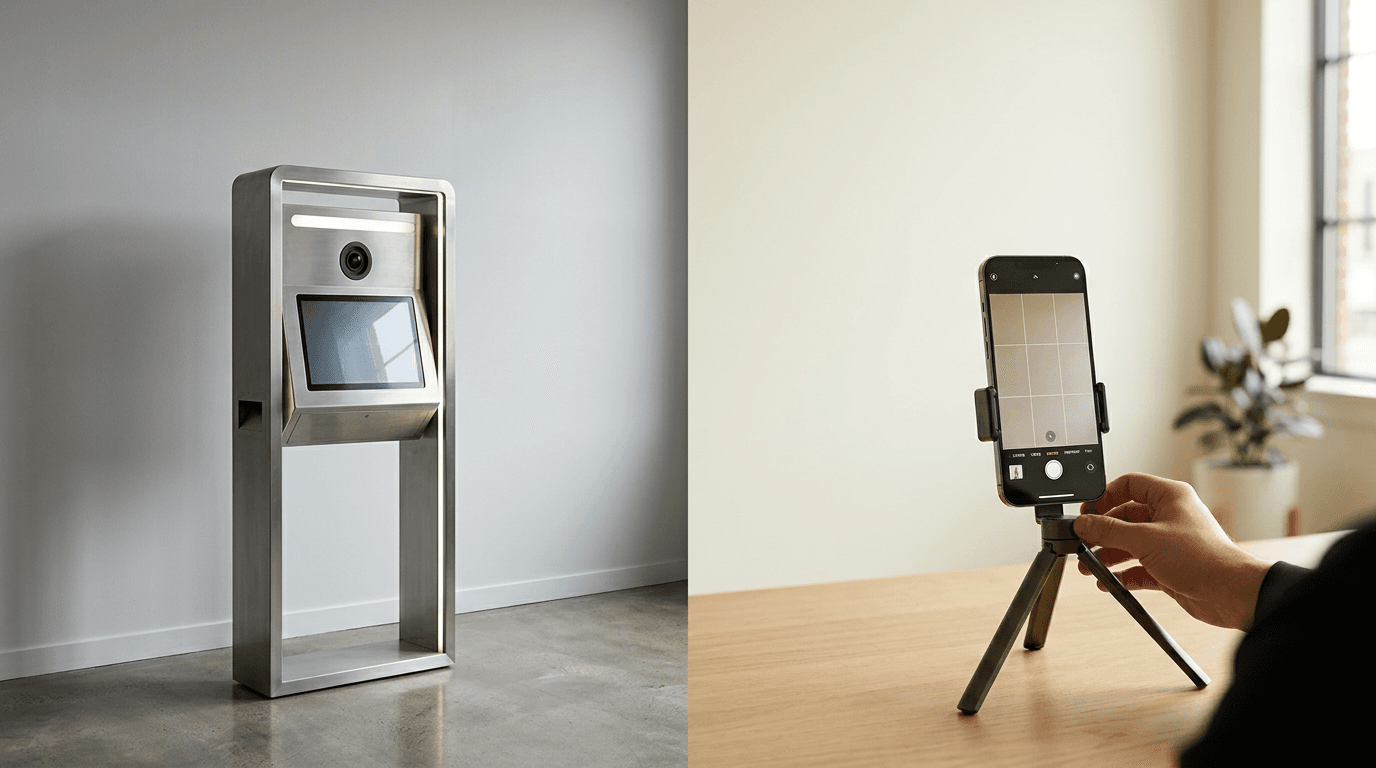
A rejected application at the consulate desk rarely happens because you filled out the form incorrectly. It usually happens because the background in your fototessere passaporto carries a faint shadow, or a glare on your eyeglasses triggered a biometric scanner's failure protocol. Adults can step into a local machine to solve this, but parents photographing dependents face a stricter operational challenge. Traditional physical capture networks provide instant prints but mandate rigid poses. Digital generation software allows unlimited capture attempts from home but shifts the burden of lighting and alignment onto the applicant's smartphone.
Quick Summary
Acquiring a compliant foto passaporto requires navigating strict biometric criteria, including precise facial sizing, uniform background colors, and neutral expressions. The market offers two primary fulfillment methods: automated physical cabins that enforce environmental control, and digital applications that process user-generated smartphone images through algorithmic and manual checks.
- Physical booths guarantee lighting consistency but struggle with subjects who cannot sit unsupported.
- Digital platforms use algorithmic background removal to isolate the subject from casual home environments.
- Expert review stages catch micro-reflections and shadow gradients that automated checks frequently miss.
- Applications supporting international specifications map the final crop to exact jurisdictional rules.
Table of Contents
- Buying Guide: How to Choose a Fulfillment Method
- 1. Cabine Fototessera Dedem
- 2. PhotoAiD
- 3. Passport Photo Online
- 4. Smartphone iD
- Closing: Matching the Method to the Application
- Recommended Reads
| Product | Fulfillment Method | Features | Pros | Cons | Target Audience |
|---|---|---|---|---|---|
| Cabine Fototessera Dedem | Physical Booth | In-booth validation, No Limits accessibility | Instant physical prints | Requires travel, fixed stool height | Local adult applicants |
| PhotoAiD | Digital with Expert Review | AI editor plus manual review | 200% acceptance guarantee | Requires user to supply lit photo | Travelers wanting certainty |
| Passport Photo Online | Automated Digital Editor | Digital and physical delivery options | Unlimited attempts free of charge | 9.95€ for printed packages | Users needing multiple takes |
| Smartphone iD | Digital with Expert Review | 191 country support, secure digital codes | Dual validation, informal free tier | Physical shipping takes time | International applicants |
Buying Guide: How to Choose a Fulfillment Method
Selecting a solution comes down to how the final image is verified and delivered. Evaluating these options requires understanding the Fulfillment Method axis, which separates the market into three distinct categories.
First, the Physical Booth category controls the environment entirely. These are fixed-location machines that dictate the lighting, camera distance, and background. Because the hardware is static, the validation software only needs to verify the subject's pose and expression.
Second, the Digital with Expert Review category accepts a user-submitted smartphone photograph, runs it through an automated background removal and cropping engine, and then routes it to a human operator. The human reviews the file for subtle defects that algorithms miss, such as a localized shadow under the chin or hair obscuring an eyebrow.
Third, the Automated Digital Editor category relies entirely on machine learning models to process the image. These systems map the facial landmarks, crop the image to the specified dimensions, and replace the original background with pure white or light gray without human intervention.
Biometric standards mandated by the International Civil Aviation Organization (ICAO) do not tolerate ambient variables. Researching the baby passport photo requirements by country reveals that applications fail when edge-detection algorithms cannot distinguish a subject's hair from a slightly textured wall. You must decide whether to rely on a controlled physical space to prevent these issues, or use software to digitally extract the subject from an uncontrolled home environment.
Practical rule: Hardware validation requires the subject to conform to the machine's dimensions, while digital generation requires the applicant to build an evenly lit environment before capturing the source file.
1. Cabine Fototessera Dedem
Walking out of a municipal office after a rejected application sends many applicants directly to a local self-service machine. Cabine Fototessera Dedem operates a vast physical network throughout Italy, designed to capture official document images on demand without requiring a separate trip to a professional photography studio.

Hardware validation removes environmental variables
How does the system work? It utilizes a proprietary FOTO PDIGITAL service to acquire and validate images directly within the cabin against international security and ICAO standards. The network features the Viso 7 and Viso Evolution. These cabins deploy multilingual voice guidance to prompt the user into the correct alignment. Dedem also operates the Sunny Viso model powered by solar energy. The No Limits model specifically bypasses architectural barriers for wheelchair users. Fixed strobes handle the lighting uniformly. Consequently, the internal software only has to verify the subject's pupillary distance and expression before printing.
The structural limit of this hardware is its inflexibility regarding the subject's posture and height. While it accommodates seated adults perfectly, the rigid environment proves actively hostile to photographing newborns who lack independent neck control. Parents consulting a United Kingdom baby passport photo guide will recognize that a fixed-stool setup cannot support an infant without an adult's hands breaching the frame. Furthermore, acquiring a printed sheet of four photos requires traveling to the machine and costs between 4€ and 7€ depending on the location.
We would choose a Dedem cabin when immediate physical prints are required to salvage a same-day appointment and the subject can sit upright without assistance.
Pros
- Generates physical photo prints immediately on site
- Wheelchair-accessible models bypass architectural barriers
- Fixed lighting eliminates ambient exposure errors
Cons
- Costs between 4€ and 7€ per physical printed sheet
- Requires the applicant to travel to a specific location
- Fixed seating structure fails to support infants securely
2. PhotoAiD
PhotoAiD offers a 200% acceptance guarantee, meaning users receive a full refund plus an additional 100% of the price if authorities reject the image, according to its published policy. It operates as a web platform and mobile application focused heavily on combining automated processing with manual oversight.
The dual verification process hedges against algorithmic blind spots
The platform relies on a two-step verification sequence. An automatic AI editor first evaluates the source image to identify facial landmarks, align the crop, and replace the background with the mandated color. The file is then routed to a manual evaluation queue where human experts verify the results against the specific template requirements chosen by the user. The database holds standard sizing templates for more than 100 countries, covering domestic Italian requirements alongside foreign visas. This sequence allows users to generate a fully compliant and verified biometric photo in an average of three minutes.
This system's genuine constraint is its total dependence on the initial smartphone file. The software maps boundaries and isolates the subject, but it cannot fundamentally reconstruct severe underexposure or fix deep optical distortion caused by holding a camera lens too close to the face. If a parent reading a United States baby passport photo guide learns that shadows across the face cause rejections, they must still physically arrange even lighting in their own home before PhotoAiD can process the file.
What would make us hesitate is an environment so poorly lit that digital enhancement creates visible artifacting, but it excels when you have basic daylight and need rigorous expert validation from home.
Pros
- Backs validation with a 200% financial refund guarantee
- Combines algorithmic cropping with manual human review
- Processes final verified files in an average of three minutes
Cons
- Cannot salvage heavily underexposed source images
- Relies entirely on the user's personal smartphone hardware
- Demands the user construct an evenly lit capture environment
3. Passport Photo Online
Forcing a subject to sit perfectly still under a ticking timer creates tension that routinely ruins the capture. Passport Photo Online functions as a dedicated digital editor and mobile app designed specifically to decouple the capture phase from the validation phase, allowing the applicant to try as many times as necessary.
Unlimited capture attempts shift the pressure away from the subject
The application applies hard mathematical templates to the uploaded images. For an Italian submission, it strictly enforces the 35x40 mm size specification and mathematically anchors the crop so the face occupies exactly 70% to 80% of the total space. It allows users to take an unlimited number of photo attempts free of charge, running the alignment software over each one. Payment is only triggered when the user formally orders the final verified output. According to its published pricing, the service costs 5.95€ for a digital-only format, or 9.95€ for a combined digital and printed photo package.
The limit of this service becomes evident in its physical delivery timeline. While the digital files arrive instantly, the company ships physical photo prints to home addresses within a standard window of 2 to 3 business days. If you are reviewing a Singapore baby passport photo guide mere hours before a consular meeting, a multi-day shipping delay renders the physical package useless.
This method suits users who anticipate needing dozens of attempts to secure a compliant baseline image, particularly parents capturing toddlers who refuse to hold a neutral expression.
Pros
- Permits unlimited photo capture attempts before requesting payment
- Enforces strict 70% to 80% facial area occupation mathematically
- Delivers both digital files and physical printed sheets
Cons
- Physical print shipping introduces a 2 to 3 day delay
- Combined digital and print package costs 9.95€
- Requires the user to wait for postal delivery
4. Smartphone iD
An expatriate renewing documents late at night requires validation that does not depend on local studio hours or domestic municipal standards. Smartphone iD is a mobile application and web tool built specifically to translate local smartphone captures into universally compliant digital codes across jurisdictions.
Global compliance routing matches specifications to the target jurisdiction
The platform guarantees 100% compliance with Italian and European administrative standards by routing the image through dual verification via internal AI and human reviews. It supports specifications for 191 countries and translates its interface into twelve languages. If an applicant simply needs a profile picture for a non-official credential, the platform maintains a free version of the application specifically for informal documents that do not require expert validation, making it an excellent resource for anyone searching for a foto tessera gratis setup. The application holds an average TrustScore of 4.5 out of 5 stars based on more than 1,000 verified user reviews on Trustpilot.
The barrier to entry here is software installation friction. Because the core biometric processing and secure digital code generation sit behind a dedicated mobile application download, it introduces an administrative step that browser-based editors avoid. Users reviewing the platform's global FAQ will find they must grant camera and storage permissions to a standalone app to initiate the process.
We would hold off on this for a one-off domestic application where a simple browser upload suffices, but it is indispensable for applicants navigating multiple international bureaucracies simultaneously.
Practical rule: Do not pay for manual expert review features if the requesting authority only requires an informal ID badge; route those requests through a free unverified tier instead.
Pros
- Maps validation rules to 191 different country specifications
- Offers a free tier for informal document image processing
- Secures a 4.5 TrustScore from over 1,000 verified reviews
Cons
- Requires downloading and installing a dedicated mobile application
- Demands device permissions for camera and file storage access
- Overcomplicates simple one-off domestic photo generation
Closing: Matching the Method to the Application
Matching your situation to the right Fulfillment Method dictates whether you walk away with a verified file or a rejected application.
If your immediate bottleneck is time and you require physical prints on the same afternoon, the Physical Booth category is the mandatory path. The fixed hardware ensures the background is appropriately lit, bypassing the need to rig a home studio, provided the subject can sit upright on a fixed stool.
If you are processing applications across borders, the Digital with Expert Review category provides the necessary compliance safety net. Human operators cross-reference the algorithmic crop against international databases, ensuring that subtle lighting gradients do not cause rejections. This is critical when consulting complex documentation, such as a Germany baby passport photo guide, where stringent margin rules apply.
If you are photographing an unpredictable subject who requires dozens of attempts to hold a neutral expression, the Automated Digital Editor category removes the financial penalty of failed takes. By stripping away the pressure of a ticking timer in a public space, applicants can secure a compliant baseline file at their own pace before committing to a purchase.